Geyser Repair
in Pinetown
Geyser repair in Pinetown starts with one question: is anything wet? A cold geyser under a dry ceiling is usually an electrical fault, often after a storm, and a dripping one is a water fault. They are fixed, priced and claimed for differently, so the test comes first.
Request a call-outWhat a geyser call covers
An electric geyser usually sits in the roof space above a ceiling, so its faults tend to announce themselves as a cold shower, a stain overhead or a pipe dripping outside, rather than anything you can look at directly.
The call covers the geyser and everything plumbed to it: the valves that control its pressure and let it vent, the drip tray it should stand in, and the pipes that carry overflow outside. When a part has failed, a replacement geyser is only priced when replacement is the honest answer, such as a tank leaking from its body rather than from a fitting.
Usually part of the job
Solar and gas water heaters follow their own rules. Mention yours when you get in touch and you will hear plainly whether it is a job for us.
A cold geyser under a dry ceiling is usually electrical
Storm season brings two kinds of geyser failure. Telling them apart decides what gets fixed, what it costs and which part of your insurance applies.
Insurers notice the weather. Reeona Chetty, head of advice at Vouch, told BusinessTech in January 2026 that KwaZulu-Natal and Gauteng are the provinces hardest hit by weather damage to homes. Dial Direct counts geyser claims among the most common property claims in the country, and points out that lightning can cause power surges that break electrical appliances. An electric geyser is one of the largest appliances in any house.
A surge does its damage through the wiring, not the water. The element can burn out, the thermostat can fail or trip its safety cut-out, or the breaker can drop and stay down. The tank stays full and dry, and the first sign is a cold shower the next morning. Nothing has leaked, so nothing needs draining, and the tank itself is usually fine.
A burst is the opposite. Water escapes from a split tank, a failed valve or a perished connection, and goes where gravity takes it: into the drip tray if there is one piped outside, or into the ceiling if there is not. SANS 10254, the standard for fixed electric geysers, calls for that tray, a temperature and pressure relief valve piped outside, vacuum breakers on both lines, an isolating valve and a pressure control valve. According to the geyser maker Kwikot, those are among the first things an insurance assessor checks.
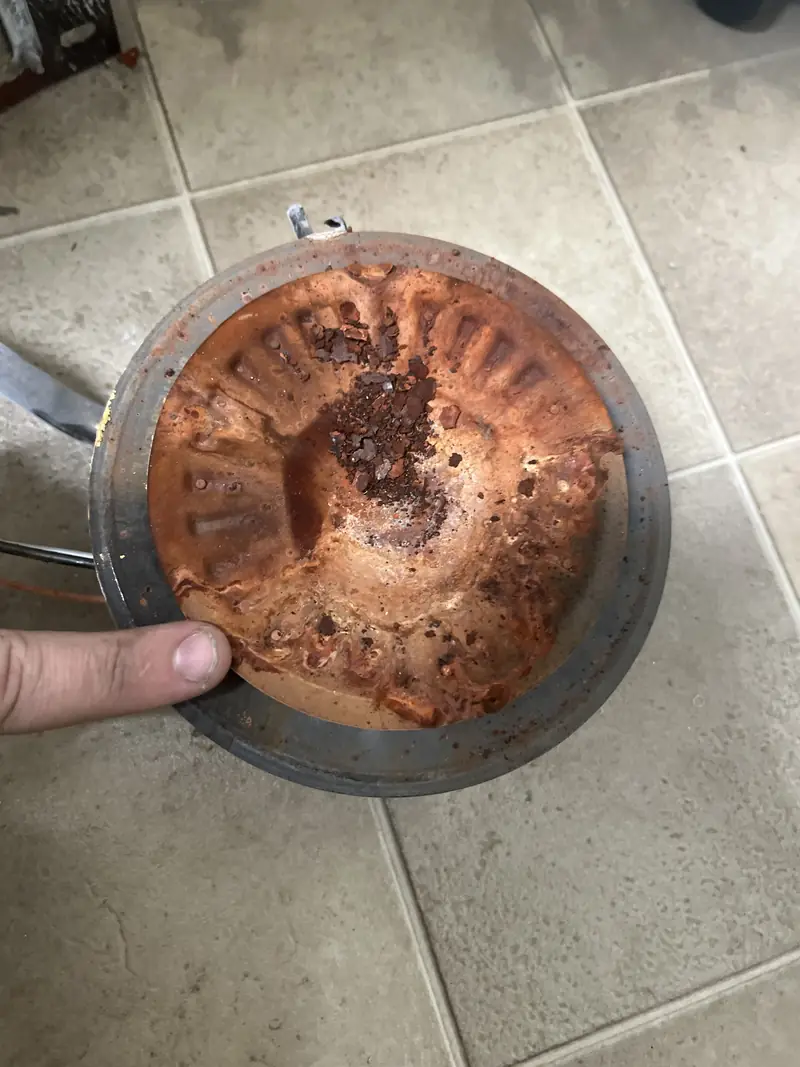
Insurers also separate sudden events from slow ones. Chetty's point was that water damage is generally claimable when it is sudden and unforeseen, while deterioration, ongoing leaks and neglect count as maintenance. A plate rusted through over years, like the one photographed at the top of this page, is wear. A tank that splits during a storm is an event. Photographs taken before anything is moved are what tell the two apart later.
So the order of work matters. First find out whether anything is wet. If it is dry, testing the element and thermostat with a meter usually finds the fault. If it is wet, the water and power go off, the tray and ceiling are photographed, and only then is anything opened.
If the geyser went cold during a storm and the ceiling is dry, check its breaker before calling it a burst, and photograph it before anyone touches it.
How a geyser call goes
The middle steps differ for a dry fault and a leak. Both begin the same way.
Power off, water off if wet
On the phone we check the geyser is off at the board and, if water is escaping, that its cold supply is closed.
Dry or wet, confirmed
The ceiling, the drip tray and the overflow pipes are checked first, then the element and thermostat are tested with a meter before anything is replaced.
Photographs, then a price
Failed parts are photographed where they are. A repair price goes on paper, with a second figure for a new geyser if the tank itself is gone.
Tested hot before we go
The geyser is refilled, switched on and checked for heating, venting and drips, and anything lifted to reach it is put back.
What changes the price of a geyser repair
There are no figures here, because one symptom can mean one small part or a whole geyser. These are the things that move the number.
Getting to it
A geyser above an open trapdoor is a quicker job than one reached by lifting ceiling boards or roof tiles.
Which part failed
An element or a thermostat is a small part. A split tank means a new geyser and the valves that belong with it.
What the installation lacks
Missing safety parts, or ones that are not piped to the outside, are added on a separate line of the quote.
Damage around it
Ceiling boards and insulation soaked by a burst are listed apart from the geyser work, so an assessor can read each part.
Geyser questions
The cost question first, then the ones people ask once the shower has gone cold.
How much does geyser repair cost in Pinetown?
It depends on which part failed and how hard the geyser is to reach, so the figure comes after the test rather than before it. A failed element or thermostat is a small repair. A split tank means a new geyser plus whatever valves the installation is missing. Where both a repair and a replacement are possible, you get both numbers in writing, and the call-out charge is explained before anyone comes.
My geyser stopped heating after a storm. Has it burst?
Probably not, if nothing is wet. Look at the ceiling under the geyser and at the overflow pipes outside. If both are dry, check whether the geyser breaker has tripped. Should it trip again straight after a reset, leave it down. A breaker that will not stay up points to the element or the wiring, which a test will confirm, not to a burst tank.
Will my insurance pay for a new geyser?
That is your insurer's call, and it usually turns on two things: whether the failure was sudden or the result of wear, and whether the installation complies with SANS 10254. Surge damage may fall under a separate power surge benefit, if your policy has one. Phone your insurer before agreeing to a replacement, and keep the photographs.
My insurer wants to send its own plumber. Can I still use you?
That depends on the policy. Some insurers only pay their appointed plumber; others pay against an approved quote. Ask yours which applies before anyone starts work. If you do use us, the quote and the invoice are itemised so the assessor can match each line to the claim.
Why does the pipe outside drip when the geyser is on?
That pipe is usually the outlet of the temperature and pressure relief valve, or of the drip tray. A steady drip from the relief valve can mean the valve is worn, or that more pressure is reaching the geyser than its pressure control valve should allow. Water from the drip tray pipe means something above the tray is leaking. Either is worth a look before it turns into a stain on the ceiling.
If the geyser cannot be repaired, do you replace it?
Yes. A replacement is quoted with everything SANS 10254 asks for: a drip tray piped outside, a relief valve, vacuum breakers, a pressure control valve and an isolating valve. A plumbing certificate of compliance should come with new geyser work, so ask for it, together with the PIRB number of the plumber who signs it.
Does surge protection help with storms?
It is what insurers themselves suggest: Vouch's storm-season advice includes power surge protection to prevent damage during lightning storms and outages. Fitting it is electrical work, so it belongs to an electrician rather than a plumber.
Water is coming through the ceiling under the geyser. What now?
Switch the geyser off at the board. Close its cold supply, at the isolating valve near the geyser or at the main stopcock if you cannot reach it, and open a hot tap to let the pressure off. Put a bucket under the drip and photograph the ceiling before it is disturbed, then ask for a call-out. The emergency page goes through those first minutes in more detail.
Often comes up alongside a geyser fault
Tell us about the geyser
Say whether anything is wet, and whether it started during a storm. We phone back to talk through what to check and how the call-out is charged.
Where we come out to
There is no shop or yard to visit: The Pinetown Plumbers comes to you. If your suburb is missing from the list, ask anyway.
- Pinetown CBD
- New Germany
- Westmead
- Cowies Hill
- Sarnia
- Ashley
- Caversham
- Padfield Park
- Hatton Estate
- Paradise Valley
- Mosley Park
- Farningham Ridge
- Mariannhill
- Kloof
- Westville
- Hillcrest
- Queensburgh